Apparel, Footwear & Accessories, Trend Identification
Menswear Fall 2023 Buyers’ Guide
The most commercial trend highlights to back from the Fall 2023 runways, paired with data insights.

Blog
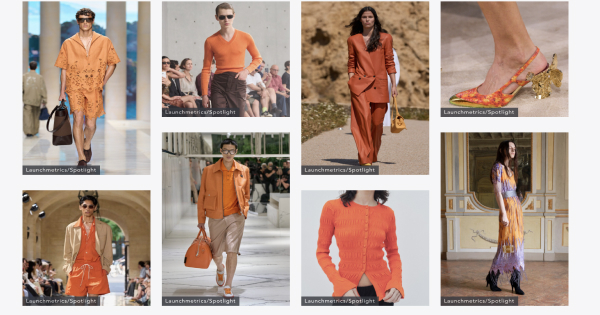
Traditional trend forecasting is qualitative and long-range by design. A panel of experts reads runway shows and cultural signals, then issues a seasonal call 18 to 24 months ahead of the sell window, with little to no input from actual sales data.
That gap is where six-figure buys go wrong. Traditional forecasting isn’t losing ground; it’s already lost you precious OTB.
So is legacy trend forecasting still worth its budget? Sure, a beautiful quarterly trend presentation is nice. But does it get you the answers you need?
For EDITED customers, the answer is already clear. Take Cider, whose team shared: “EDITED is the solution I use most often to research fashion trends.” What started as a trend-tracking tool has become a company-wide resource, connecting product, pricing, and creative teams around a single source of trend insight.
Qualitative forecasting has a structural problem it can’t fix: it lives outside the tools where buying decisions actually get made, and it was never built to answer the only question a buyer or merchandiser has: will this actually sell, and how much should I buy?
So let’s say what we’re all thinking: this isn’t fit for purpose for a retail industry that moves at social media speed and answers to a finance team every quarter. Retailers need confidence before they commit, not a finger in the air based on ‘inspiration’ years ahead of when they’ll sell.
Data-backed forecasting ranks trends by commercial adoption at scale, built on the world’s deepest classified retail dataset, not snippets. Powered by real-time global competitor pricing and assortment, EDITED is a source of truth for all teams,not just buyers and designers reviewing a quarterly trend report.
That means tracking these three things:
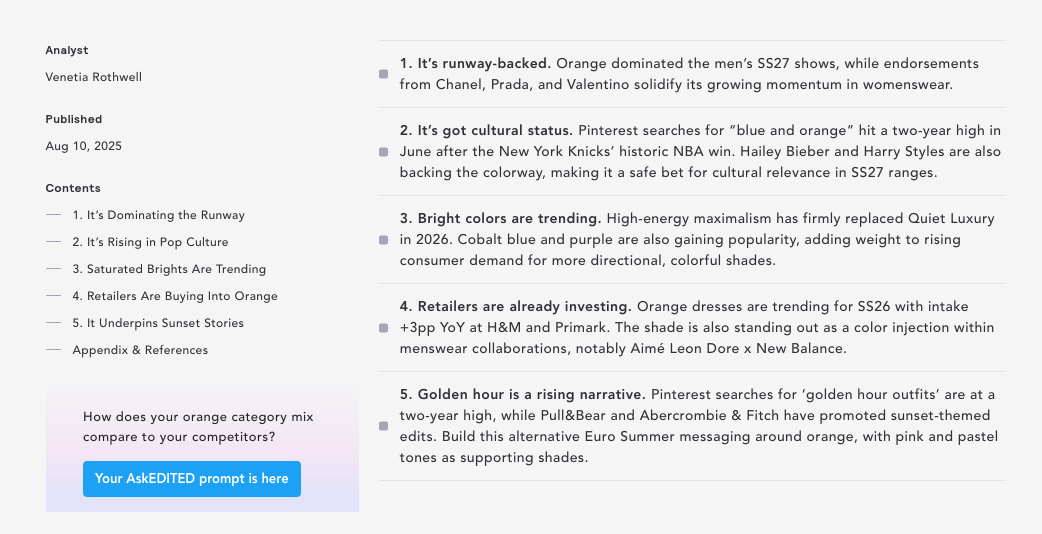
The output looks less like a seasonal color palette and more like a ranked, evidence-backed list. What’s accelerating, what’s plateauing, what’s already dead in the water, each one tied to specific pricing and assortment data behind it.
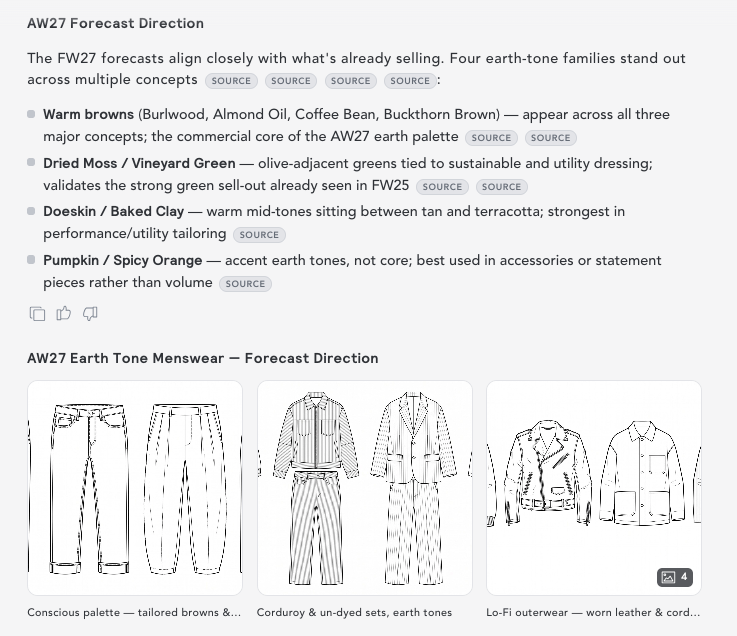
Here’s what that looks like in practice. Say you’re trying to figure out what colors to invest in for menswear AW27. A traditional, panel-led forecast will point you to a broad color direction. ‘‘Earthy tones ” with 6 Pantone shades shared; expect olive, brown, and butter yellow through the season. That’s a clean, confident headline but close to useless on its own, because “earthy tones” doesn’t tell you how to buy by shade, what’s performing well vs what doesn’t, and where there’s whitespace.
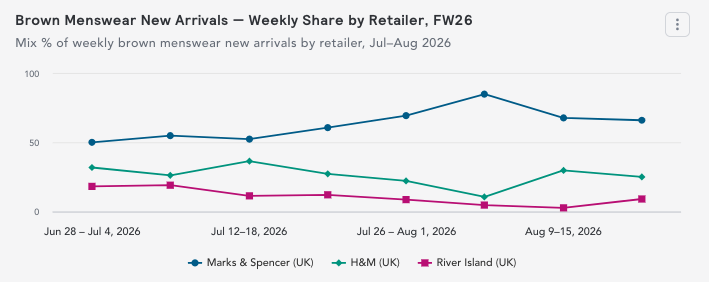
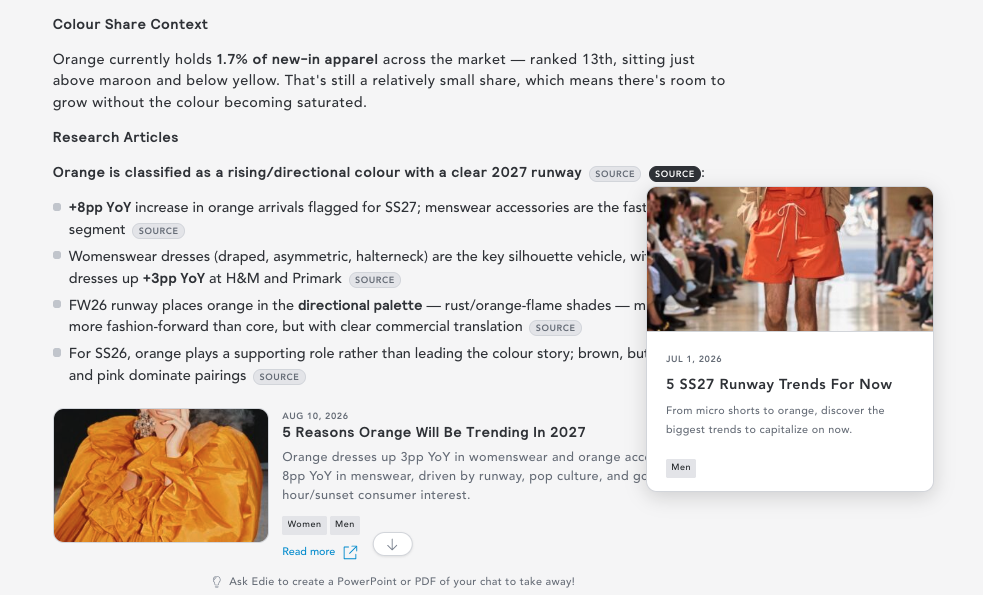
Here’s what data-backed trend forecasting is when using AskEDITED. You type in “What earth tones should I invest in for AW27 menswear based on performance this year?” And get data-backed answers in seconds, with sources.
Covering direct competitors’ performance:
The AW27 forecasts back it up:
Here’s the gap between editorial opinion and commercial proof in one table.
| Capability | Traditional Trend Forecasting Platform | EDITED |
|---|---|---|
| Trends ranked by commercial adoption and strength | ✗ | ✓ |
| Real-time competitor pricing and assortment data | ✗ | ✓ |
| Usable by merchants, buyers and planners, not just designers | ✗ | ✓ |
| 120+ regions tracked | <120 | ✓ |
| Quantified market data, not editorial opinion | – | ✓ |
| Runway insights, validated commercially | – | ✓ |
| Conversational AI for instant retail answers | ✗ | ✓ |
| Works inside Claude, ChatGPT via MCP | ✗ | ✓ |
| Cultural and demographic trend direction | ✓ | ✓ |
| Onsite/in-person presentations | ✓ | ✓ |
✓ Capable – Partcial/limited 𐄂 Not capable
The verdict is simple. Ranking by real-time data identifying commercial strength is what turns personalized insight into a decision your team has confidence in.
Do you catch yourself asking “Am I too late to market for this?” or “Is this still worth a 12-month lead time?” Here’s how to actually answer that confidence: data, not gut feel.
Start with the signals, not the market at large. Check whether a trend is gaining assortment share and holding price in your specific regions and categories, not just trending broadly. Rank trends by commercial strength rather than treating everything in a report as equals. Then you’ll know fast whether the move is to rebuy, hold, or exit.
Then check where it sits in its lifecycle. EDITED holds over 12 years of historical market data, so you’re not guessing:
Combine live regional signals with historical trajectory, and you can answer “are we too early,” “are we too late,” and “is this still worth it” with confidence rather than instinct.
Yes. 75% of fashion executives are already prioritizing AI for demand forecasting, inventory optimization and cost control, according to McKinsey’s State of Fashion 2025 survey. The value isn’t replacing forecasting expertise, it’s making that expertise fit for retail: commercially validated trend data you can act on immediately. Now you can get straight to the answer, without waiting for the trend presentation or report and interpreting it yourself for your customer and market.
That’s what AskEDITED does. AI built on the world’s largest aggregation of global retail data, grounded in real-time pricing and assortment data across 120+ regions, 90,000 brands, and 5bn+ SKUs. All of it is ranked by commercial strength, so every answer is backed by evidence, not a guess. Ask any question, like which color trends are emerging in a specific category this season, and get a data-backed answer ranked by commercial strength, sources included, no static report to decode on your own.
And this is just the beginning. If you’re already building agents or agentic workflows internally, MCP (Model Context Protocol) connects your business straight to the market. EDITED’s MCP puts that same world-class retail data to work exactly where you’re already building. No exports, no copy-paste, no waiting.
Want to see it work in reality? We’d love to show you.
Example prompts we can bring to life for you:
Stop guessing the season after next. Start buying with confidence. Book a demo with one of our retail AI experts to see it in action.
How far ahead should fashion trend forecasts look?
Traditional forecasting calls trends 18 to 24 months out, based on runway shows and mood boards. Commercial-adoption data works on a shorter loop: it can confirm or kill a trend call within a single selling season by tracking real shifts in assortment and price as they happen.
What’s the difference between a fashion trend and a fad?
A trend keeps gaining assortment share, holds price, and spreads across regions over multiple seasons. A fad spikes fast and reverses just as fast, usually visible in markdown speed within weeks rather than months.
Can AI replace fashion trend forecasters?
No. AI replaces the wait for a scheduled report or trend presentation, not the judgement call. It gives forecasters and buyers a data-backed starting point instead of a blank page, so the decision is faster, not automated away.