By Krista Corrigan, Senior Retail Analyst, EDITED
Get stats at a glance:
- Roughly 11.9% of surveyed US adults now identify as active users of a GLP-1 medication. Retailers are responding by consolidating assortments into core mid-to-small sizes rather than the extended ranges built up over the last decade.
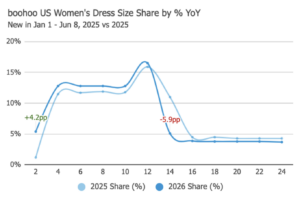
- H&M has eliminated 3XL and 4XL entirely, Aritzia is phasing out lettered XXL in favor of a 0–16 numeric range, and boohoo has cut extended dress sizes 14+ by 8.8pp.
- M&S and Debenhams are visibly retreating from plus-size ranges in favor of Petite and Alpha sizing, while John Lewis is growing plus-size volume.
- Walmart (US) and Asda’s George (UK) are moving the opposite direction, expanding extended sizes as lower-income shoppers face more friction accessing GLP-1s.
- Mainstream runway casting has thinned out this season, but a growing cluster of indie designers and curve focused shows are pushing the opposite message, and the gap between the two is exactly the kind of signal retailers need real data to interpret.
What is the GLP-1 effect on fashion sizing?
A few years ago, this was a pharmaceutical conversation but has swiftly shifted to an inventory one and it’s moving faster than most retailers’ buying cycles were built to handle.
Roughly 11.9% of surveyed US adults, roughly one in nine shoppers, identify as active GLP-1 users. That number is large enough now to show up in aggregate sizing data rather than remaining a niche storyline.
The pattern across the market is consolidation. Extended sizes are getting pulled back, and the buying dollars previously dedicated to them are shifting into core mid to small ranges.
In some cases, sizes are disappearing outright. 3XL, 4XL, and 20-26 have seen real cuts or even full cancellations across multiple retailers. This indicates a strategic pivot rather than a seasonal dip, and one that’s likely to keep accelerating as GLP-1 adoption climbs.
Which US retailer are cutting extended and plus sizes?
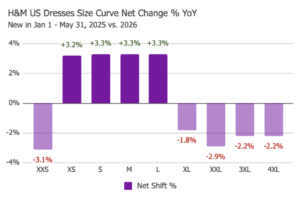
H&M (US) has been the most aggressive mover. It eliminated 3XL and 4XL completely, both dropping from 2.2% of its SS26 dress assortment to zero, while XXL fell 2.9pp, XL fell 1.8pp, and XXS was trimmed by 3.1%.
That freed up share went straight into core XS to L, which rose roughly 3pp on average. It’s a clean, aggressive strategy: shrink the tails, reinvest in the middle.
Aritzia (US) is taking a different approach entirely. Rather than simply cutting extended sizes, it’s replacing lettered sizing (XS-XXL) with precise numerical ranges (0-16), and the share of dresses in lettered sizes is down 23pp year over year.
The effect looks similar to what H&M is doing, since XXL is being phased out in the process. However, the underlying motivation is different, reading more like a brand repositioning than a GLP-1 response. Numerical sizing signals a more tailored, boutique feel, and it’s a way for Aritzia to elevate how premium the label feels at the point of sale, with the sizing consolidation as a byproduct rather than the goal.
Mango (US) and boohoo (US) tell a more familiar version of the same story. Mango has shifted over 60% of its dress options into core sizes 4-8, up 8pp year over year, while cutting extended sizes 16-20 by 6pp. boohoo has moved extended sizes 14+ from 35.5% down to 26.7% of its dress range, with size 14 alone losing nearly 6 percentage points of options.
Anthropologie (US) is doing something slightly different again. Rather than cutting plus sizes outright, it’s shifted dollars into flexible alpha sizing (XXS-XL, up from 48.5% to 53%), on the theory that adaptable straight sizes handle body fluctuations from GLP-1 use better than a rigid numeric fit. Dedicated plus sizes dropped from 10.5% to 9% in the process, which is a quieter retreat than H&M’s but a retreat all the same.
Which UK retailers are cutting plus sizes, and which aren’t?
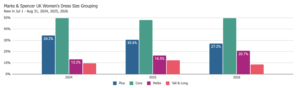
Marks & Spencer (UK) is retreating steadily. New in plus share has fallen every year, from 34% in 2024 to 27% in 2026, with the steepest cuts hitting upper plus sizes. UK 22 and 24 combined dropped from 2.2% to just 0.4%.
That space went to Petite, which nearly tripled over the same period, from 12.2% to 17.9%. This lines up with CEO Stuart Machin’s turnaround strategy, which is explicitly aimed at younger shoppers. It’s also worth noting M&S launched a “Nutrient Dense” food range in January 2026 targeting GLP-1 users. The clothing shift and the food shift are almost certainly the same customer bet.
Debenhams (UK) moved even faster, with plus share falling from around 23% to 17.4% in a single year, with the space reallocated to Alpha sizing. However, it’s worth keeping in mind that Debenhams.com now runs as a Boohoo operated marketplace. This drop could also be a result of which brands get shelf space than an intentional response to plus size demand.
John Lewis (UK) is the one worth watching most closely. Plus size units are actually climbing year over year, but the share is falling, from 22.3% to 19.2%, simply because everything else is growing faster. That tracks with the retailer adding 100 new fashion brands as part of its $1bn turnaround. Not a retreat yet, but a slowdown worth watching next season.
Which retailers are expanding extended sizing instead of cutting it?
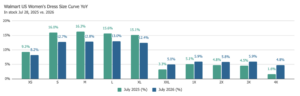
Walmart (US) is moving in the opposite direction from almost everyone above. In stock women’s dresses show straight sizes (XS-XL) falling from 72.3% to 59.1% year over year, while extended sizes (XXL, 0X-5X) surged from 23.9% to 32.6%, with 4X seeing the biggest single jump.
The logic here is straightforward and worth stating plainly: high out-of-pocket drug costs and insurance friction mean GLP-1 adoption skews lower among value shoppers. That’s real, durable demand that other retailers are actively vacating, and Walmart is simply the one picking it up.
Asda’s George (UK) shows the same pattern. Plus share has stayed essentially flat and remains the highest of any UK retailer tracked, at 43.5% in both 2024 and 2026, with sizes 10-22 all getting roughly equal investment. In a market where most major brands are shrinking their plus-size offering, holding flat is a strategic choice rather than a failure to act.
How are apparel brands redesigning garments for GLP-1-driven body changes
Sizing isn’t the only lever retailers are pulling. A lot of the more interesting activity right now is happening at the garment level, where brands are designing around uncertainty instead of trying to predict exactly where the size curve settles.
Adjustable waistband bottoms more than doubled month over month in May 2026, and belted bottoms saw a 50% year over year surge in new arrivals. Hidden drawstring pants are picking up too, with Nordstrom’s options up 18% year over year.
Shapewear intake grew 28% year over year at boohoo (UK), and Tommy Hilfiger (US) is adding side adjusters to menswear trousers for an extra 1 to 2 inches of cinch without a belt. None of these are dramatic redesigns, but small, flexible details that let one garment work across a wider range of bodies.
Taken together, this is the industry hedging its bets. If you’re not sure where the size curve settles, you build garments flexible enough to not need to know.
It’s also the kind of shift that’s easy to miss if you’re only tracking headline size curve data. Spotting that adjustable waistbands doubled in a single month, or that a competitor quietly added side adjusters across its trouser range, takes granular, current assortment data rather than a seasonal trend report. That’s the level of detail AskEDITED is built to surface, turning a change like this from something you notice after the fact into something you can act on.
Does NYFW runway casting reflect the sizing shift?
It’s no secret that runway casting has been thinning out this season, and it’s been visible enough that industry press has picked up on it without needing a report to confirm it. Theories range from a return to Y2K era body standards to GLP-1 use.
That matters beyond the runway. Size inclusivity advocates have flagged, reasonably, that thinner casting now tends to show up as thinner retail buys later, since runway presentations are still one of the earliest commercial signals designers and buyers act on.
At the same time, there’s a real pushback worth highlighting. Designers like Christian Siriano and Collina Strada have stayed committed to diverse casting even as the broader runway pulled back, and SFWRUNWAY’s NYFW Curve carved out a dedicated showcase built entirely around size-inclusive casting.
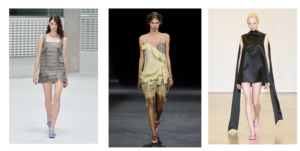
Image: Left to right: Mulberry, Erdem & Sandy Laing SS27 NYFW
Frequently asked questions
What percentage of shoppers currently use GLP-1 drugs? Roughly 11.9% of surveyed US adults, or about 1 in 9 shoppers, now identify as active GLP-1 users, a number large enough to show up in aggregate apparel sizing data.
Which retailers have cut extended or plus sizing because of GLP-1s? H&M has eliminated 3XL and 4XL entirely, Aritzia is phasing out lettered XXL for numeric 0-16 sizing, Mango and boohoo have both cut extended dress sizes, Anthropologie has shifted dollars into alpha sizing over dedicated plus sizes, and in the UK, M&S and Debenhams have both reduced plus-size share in favor of Petite and Alpha ranges.
Which retailers are expanding extended sizing instead of cutting it? Walmart (US) and Asda’s George (UK) are both growing their extended-size assortments. Walmart’s extended sizes (XXL, 0X-5X) rose from 23.9% to 32.6% year over year, while Asda’s George has held plus share flat at 43.5%, the highest of any UK retailer tracked.
Is John Lewis cutting plus sizes too? Not yet. Plus-size units at John Lewis are climbing year over year; its plus-size share is falling only because the retailer’s overall assortment is growing even faster.
How are brands redesigning garments instead of just cutting sizes? Retailers are adding flexible construction details such as adjustable waistbands, hidden drawstrings, belted bottoms, shapewear, and side adjusters so a single garment can fit a wider range of bodies without predicting exactly where the size curve settles.
Is NYFW runway casting getting less size-inclusive because of GLP-1s? Mainstream runway casting has thinned out this season, a trend industry press links to both Y2K-era body standards and rising GLP-1 use. At the same time, designers like Christian Siriano and Collina Strada, along with SFWRUNWAY’s NYFW Curve showcase, have kept size-inclusive casting central to their shows.