In an EDITED survey of head office professionals at 167 global retailers in October 2026, 82% said they use AI at work, but only around a third use it daily. A big part of the gap is trust.
Copilot and ChatGPT are great at drafting and summarizing: the email thread, the range review deck, the 40 pages of notes. The risk starts when you ask them for a number about your market.
They’re working from training data that’s months old, or whatever a web search turned up. They can’t see what’s on shelf or selling today, but they’ll answer confidently anyway.
That’s true of every AI tool, it’s only as good as the data it can reach, so the real question is what you’ve connected yours to.
Ask these eight questions before you take an AI answer into a range review. Here’s what each one tests, and why most tools fail it.
Can ChatGPT or Copilot tell you what changed in your market yesterday?
No, not on its own. A generic AI tool only knows its training data and what a web search finds today. Even when it does open a page, it may only take one section.
Markdowns went live across your comp set last night. A competitor dropped new season on Tuesday and pulled two styles on Wednesday. The model can’t see any of it unless a live data feed is connected. Test it: ask what changed in your market last week. If the answer has no dates, you’re reading old news.
Can ChatGPT count competitor SKUs and price points?
Not across a full range. To count options or map a price architecture, you need every product in a competitor’s range, stored as data. A few web pages read as text can’t be totaled, averaged or compared. And if the tool only reads part of a page, the total is only part of the range. Count the dresses on half a page and you’ve undercounted, with no warning. Here’s the difference:
- What a general tool gives you: Zara has launched a lot of new dresses this season.
- What a buyer can act on (illustrative): 47 new-in dresses, $49 to $169, averaging $89, across 12 colorways, dropping Tuesdays and Fridays.
Only the second one helps you build a range plan.
Can AI tell that yoga pants and leggings are the same product?
No, and without it nothing else works. The same pair of leggings can appear at 40 retailers, in four languages, under 40 different product names: leggings, yoga pants, jeggings, running tights. In the US they’re pants. In the UK, pants are underwear. Without consistent product classification, there’s nothing to group by, so you can’t compare like-for-like. A general tool guesses the match on the fly, and guesses each time differently.
Can ChatGPT show where its numbers come from?
It can cite the pages it read, but not the ones it skipped. And citing a page doesn’t mean it read all of it. If a retailer’s category page loads 50% of its products before the rest sit behind “load more” or a scroll (illustrative), the AI answers from what it saw while naming the whole page as its source. The link checks out, but the answer only covers half the range.
If a buyer can’t see the source, they won’t act on the number. Ask which retailers it looked at, how many products and over what dates. A good answer names them and lets you click through. A number with no source won’t survive your merchandising director.
Will ChatGPT tell you when it has no data?
Usually not, and this is the costly one. A general tool fills the gap with a confident, well-written answer. Nothing shows you where the data should have been. “I don’t have promo data for that retailer in that market” beats a plausible number. You can plan around a gap you know about. You can’t plan around a wrong number nobody caught.
How many retailers does ChatGPT actually check?
Usually a handful, and it won’t tell you which. A general tool reads whatever pages it finds that day. To spot real assortment gaps, see a trend building or tell a replenishment from the start of a markdown, you need full assortments tracked every day. Ask how many retailers it checked. If it can’t say, that’s your answer.
Will ChatGPT give you the same answer next Monday?
Probably not. Anything in your weekly trade report has to be repeatable, or nobody can tell whether the market moved or the tool did. If the tool checks different pages each time, the answer changes too, and your trend line tracks the tool, not the market. Ask the same question twice and compare.
Can AI tell you what a competitor price means for your buy?
Not without context. A competitor’s price only means something next to its markdown cadence, its promo timing, its stock position and what the rest of the category did that week.
In a range review, that’s the difference between knowing a rival went to $49 and knowing it did it in week three, across 60% of its option count, while sell-through on your equivalent was already slowing.
McKinsey reckons merchants could win back up to 40% of their time by handing repetitive work to AI. That only pays off if what comes back is a recommendation, not a figure you then go and check.
Why do ChatGPT and Copilot get retail questions wrong?
All eight come down to one thing: the data the tool can reach. Whether it’s old training data, a handful of retailers or half a page, the gap is always incomplete data. The models are capable. Connect one to complete, structured retail data and it has the evidence to answer every one of these questions.
What makes EDITED data different?
It’s not just the size of the dataset. Three things make the answers reliable.
We crawl full assortments across 4,000+ retailers, every day, and have done for 15 years. That’s how you see what is missing from an assortment, how a trend is building, and what a change means: a replenishment landing, a markdown starting.
We classify every product with models trained on years of retail images and text. Category, color, pattern, fabric, the lot, the same way every time. Leggings are leggings in every language and every market, so like-for-like holds.
We bring pricing, assortment, promo and trend data together. So the answer is ready for your trade meeting, not a number you still need to check.
All of it reaches your AI tool through EDITED MCP, which connects EDITED’s pricing, assortment, promo and research data to Claude, ChatGPT, Copilot and whatever your team is building:
- 15+ years of normalized history
- 4,000+ retailers and 600,000+ brands
- 8Bn+ SKUs classified every day, across 100+ countries
- Apparel, home and beauty
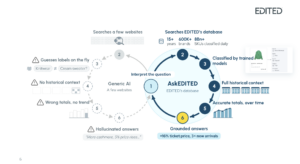
image: Illustrative example of how a generic AI tool and AskEDITED handle the same question.
The EDITED connector for Claude went live on November 4. Setup is a few clicks in Claude’s connector directory, no technical work needed. Technical teams have had the same data through the EDITED MCP server since August, in Claude Code, Cursor, VS Code or agents they build themselves. Setup documentation is at build.edited.com.
AskEDITED is the version for teams who want the retail reasoning included rather than built. Same dataset, with Edie, EDITED’s retail agent, running the analysis and showing her sources.
What changes when you connect your AI tool to EDITED?
Connect the same tool to EDITED and ask the eight questions again:
- Yesterday. The markdowns that went live last night, with dates on them.
- Counting. 47 new-in dresses, $49 to $169, averaging $89, because every product is a record rather than a sentence.
- Classification. Leggings are leggings across 40 retailers and four languages, whatever they’re called.
- Sourcing. Every answer names the retailers, the products and the date range.
- Gaps. Coverage is explicit, so you can see what the answer rests on and what it doesn’t.
- Coverage. 4,000+ retailers, not whatever loaded that day.
- Repeatability. Same data, same classification, so week-on-week changes reflect the market, not the tool.
- Meaning. Price read against markdown cadence, promo timing and stock position.
You keep the tool. What changes is the data behind it.
Run the eight questions on your current tool first. Then connect EDITED and ask again. The answers make the case better than we can.
FAQ
Can ChatGPT or Copilot see live competitor pricing?
Not on their own. A general model works from training data with a fixed cutoff, plus whatever pages it fetches in the moment. Connect it to a live retail dataset and it can, which is what EDITED MCP and the EDITED connector for Claude are for.
Can Claude do retail market analysis?
Not on its own, for the same reasons as any general AI tool. Connect it to EDITED through the Claude connector and it can analyze live pricing, assortment and promo data across 4,000+ retailers.
Is EDITED MCP a replacement for Copilot or ChatGPT?
No. It sits underneath them. Your team keeps the AI tool it already uses, and EDITED supplies the retail data that tool cannot reach on its own.
Do I need a developer to set it up?
Not for Claude, Copilot, Gemini or ChatGPT. EDITED customers find EDITED in Claude’s connector directory, sign in with their EDITED account and approve access. Technical teams can use the EDITED MCP server directly in Claude Code, Cursor, VS Code or their own agents.
What data does EDITED MCP cover?
Pricing, assortment, promotions and messaging, plus EDITED’s expert research, across apparel, home and beauty. That runs on 15+ years of normalized history covering 4,000+ retailers, 600,000+ brands and 8Bn+ SKUs in 100+ countries.
What is the difference between EDITED MCP and AskEDITED?
MCP brings EDITED data into the AI workspace your team already uses. AskEDITED is EDITED’s own conversational product, where Edie does the retail analysis for you and returns charts, product cards and sources. Plenty of teams use both.