Co-authored by Jen Day, Group Product Manager
MCP vs API: the short answer
- EDITED’s MCP and API are two ways into EDITED data, built for different jobs. With MCP you start by asking. With the API you arrive ready to build.
- EDITED’s MCP also reaches EDITED Research and EDITED Messaging data, which have no API. EDITED Market data is available both ways.
- Which one fits depends on the job in front of you, not on which is better.
MCP vs API: when should you use each one?
The quickest way to choose is to start from what you are about to do.
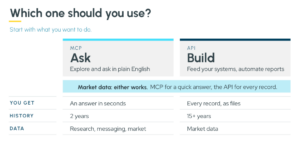
| EDITED MCP vs API at a glance |
| Feature |
EDITED MCP (ask) |
EDITED API (build) |
| Built for |
AI assistants and the people using them |
Developers’ code |
| What it is |
A protocol (the “how”) |
An interface (the “what”) |
| What you bring |
A question |
A plan |
| Good for |
Exploring, prototyping, working with an agent |
Feeding your own systems, automating anything repeated, working at scale |
| Data reached |
Research, Messaging and Market data |
Market data |
| What you get |
Answers in seconds, on a clean shared vocabulary |
Full records, raw text included |
| Historical data |
Two years |
The full archive (15+ years) |
| Data per request |
50 rows per call |
Whole files |
| Pulling 24,154 records |
About 480 calls |
One job: 3 files (about 150 MB) in about 2 minutes |
People build things with MCP too, so why is “build” the API’s verb? Because of what it takes to get started. Once MCP is connected, you can begin with nothing but a question. With the API, you need to know what you are building before the first call.
Choose the API when the data has to reach your own systems without a person asking for it each time, and when the same job will run again and again. Say you prototype a weekly report by asking an agent. Once it works, running it every week is a different job: you want the same steps, in the same order, with the same result each time. That is what the API is for, with a script making the calls, or code calling the MCP directly, and the AI reasoning saved for the results instead of the calls. The API also reaches further back, with the full archive of 15+ years against two years through MCP, and it delivers more rows at a time.
For EDITED Market data, either method works. MCP gives you the answer, and the API gives you the records behind it. The tradeoff is who does the interpretation and how repeatable the result needs to be. With MCP, the model interprets live, for each question. With the API, whoever builds the pipeline interprets once, up front, and every run after that behaves the same.
Case study example: Has Gen Z really cancelled polyester?
There has been a lot of talk of a backlash against polyester. So we put one question to EDITED’s data: is the backlash showing up in the sales?
EDITED Research started with what retailers are actually bringing in. Across women’s apparel arrivals from Q3 2024 to Q3 2026, polyester’s share rose at all three retailers in the analysis. So while sentiment is turning against polyester, the assortment is moving the other way.
| Polyester share of women’s apparel arrivals, Q3 2024 to Q3 2026 (EDITED Research) |
| Retailer |
Q3 2024 |
Q3 2025 |
Q3 2026 |
| Mango |
43% |
56% |
55% |
| Urban Outfitters |
37% |
34% |
44% |
| Zara |
27% |
39% |
41% |
Then we checked four other US retailers with EDITED Market data: Abercrombie, American Eagle, Hollister and Old Navy. We looked at the share of women’s options that contain any polyester, linings and pockets included, comparing September 2025 with September 2026. The answer: no surge. Two retailers were steady and two eased. Hollister went from 84.0% to 79.6%, and Old Navy from 53.9% to 47.7%.
So, has Gen Z cancelled polyester? Not at these four.
The more useful part for anyone working with EDITED data is how we got there. We asked the question through EDITED’s MCP and had an answer in seconds. Then we went to EDITED’s API to look at the records behind the number. Two tools, two jobs, and the difference comes down to a verb: with MCP you start by asking, and with the API you arrive ready to build.
What is an MCP, and what is an API?
API stands for Application Programming Interface. It is built for developers’ code: an application is coded to send a request by a set of rules, much like a template, and gets an expected response. MCP stands for Model Context Protocol. It is built for AI assistants and the people using them: an AI agent gets the context it needs to make a request and process the response. One is an interface, the “what,” and the other is a protocol, the “how.” In the end, they do a similar job for you here: retrieving data.
So when you hear that a company offers an MCP, think: this is a way for my AI agent to connect to their system and retrieve information. When you hear that it offers an API, think: this is a way for me to write code that communicates with their system and, generally speaking, retrieves information. Nothing stops you from reaching an MCP without an agent, by writing code as you would for an API. It is simply built with AI assistance in mind.
If part of you is thinking “so this is just an API with fewer steps,” you’re not totally wrong. That’s kind of the point. Many MCPs are thin layers around an API that give an agent what it needs to use it. EDITED’s is not, as the next section shows. They are separate systems, and for EDITED Market data they read the same data.
What data can EDITED’s MCP reach that the API can’t?
EDITED’s MCP reaches data the API doesn’t. EDITED Research and EDITED Messaging are available through MCP only.
That is why the polyester question was a good test. One conversation through MCP could draw on the EDITED Research article, EDITED Messaging and EDITED Market data together. The Market data part is the table below: the share of women’s options with fiber data that contain any polyester, including linings and pockets. It measures whether polyester is present, not how much.
| Share of women’s options containing any polyester, US, Sept 2025 vs Sept 2026 |
| Retailer |
Sept 2025 |
Sept 2026 |
Change (percentage points) |
| Abercrombie |
73.4% |
74.7% |
+1.3 |
| American Eagle |
26.6% |
26.1% |
-0.5 |
| Hollister |
84.0% |
79.6% |
-4.4 |
| Old Navy |
53.9% |
47.7% |
-6.2 |
Source: EDITED Market data, US, Sept 1 to 26 in each year. Old Navy’s data was stale for two weeks in September 2026.
What does the EDITED API give you that MCP doesn’t?
A figure like “about 80% of Hollister’s women’s options contain polyester” raises two questions: how many records is that, and what is inside one? Those are API questions.
How do you download every record with the Jobs API?
The week of September 20 to 26, 2026 held 24,154 women’s options across the four retailers, and every record includes its composition. With the Jobs API you submit a job, poll it, and download the result: three files, about 150 MB, in about two minutes. Through MCP, at 50 rows a call, the same set would take roughly 480 calls. MCP is the right tool for the question. The Jobs API is the right tool for the whole set.
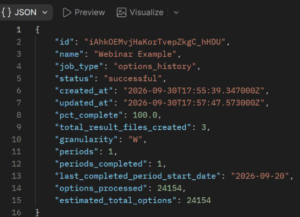
Hollister’s Ultra High-Rise Dad Jeans count as containing polyester. Here is why:
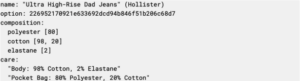
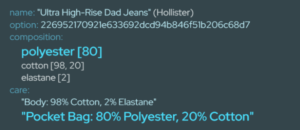
The jeans are 98% cotton in the body, but the pocket bag is 80% polyester, so the option counts as containing polyester under the “any polyester” definition. The composition numbers carry no labels, so nothing in the list says which one is the pocket. The care text does. This is the kind of detail you get from full records, raw text included.
How do you see historical data with the Query API?
The Query API returns one option as it stood on a date you choose. We made the same call for the same jeans three times, changing only the rewind date.
| Hollister Ultra High-Rise Dad Jeans: one Query API call on three rewind dates |
| Rewind date |
Days on site |
Sizes in stock |
Sell-out |
Composition |
| Aug 2024 |
39 |
39 |
No sell-out date yet |
Not yet recorded |
| Sept 2025 |
423 |
2 |
Majority sold out Oct 27, 2024 |
Included |
| Sept 2026 |
469 |
1 |
1 size left |
Included |
Composition went live in August 2025, so the 2024 record has none. That also sets the limit on how far back a composition trend can go. MCP covers two years of history, and the API covers the full archive, 15+ years.
To get started, the developer portal is at build.edited.com.
So, should you use EDITED’s MCP or API?
Different jobs, not a ranking. If you have a question, start by asking: EDITED’s MCP gets you an answer in seconds, across EDITED Research, Messaging and Market data. If you already know what you are building, the API gives you full records, the full archive and whole files. They can also work together, as the polyester question showed: discover with MCP, prototype your analysis, then drill down into the full records with the API.
To talk through which route best fits your team, book a demo.
Frequently asked questions
What is the difference between an MCP and an API in simple terms?
An API is built for developers’ code: an application sends a request by a set of rules and gets an expected response. An MCP is built for AI assistants: an AI agent gets the context it needs to make a request and process the response. Both retrieve data.
Is EDITED’s MCP built on top of EDITED’s API?
No. They are separate systems. For EDITED Market data they read the same data, but EDITED’s MCP also reaches EDITED Research and EDITED Messaging, which have no API.
Can I use EDITED’s MCP without an AI platform?
Yes. You can reach an MCP by writing code as you would for an API. It is simply built with AI assistance in mind.
How much history do EDITED’s MCP and API cover?
EDITED’s MCP covers two years of history. EDITED’s API covers the full archive, 15+ years. Composition data went live in August 2025.
How many records can EDITED’s MCP return?
50 rows a call. For a full set, such as 24,154 options, the Jobs API delivers three files in about two minutes, against roughly 480 MCP calls.
Can I use EDITED’s MCP and API together?
Yes. Discover with MCP, prototype your analysis, then drill down into the full records with the API.
How do I get access to EDITED’s MCP and API?
Start at the developer portal, build.edited.com. To learn more about which solution is right for your business, book a demo with one of our AI retail experts.