Summary
- A cautious investment climate raises the cost of a wrong call. It doesn’t lower the need for good ones.
- Margin protection right now comes from three places: whitespace, pricing precision, and markdown discipline, not from new headcount or new tools.
- The retail teams coming out ahead aren’t spending more. They’re spending smarter, with the data to prove every call to leadership.
Retailers across the Middle East are operating in a particularly cautious investment climate right now. Declining tourism, tighter consumer spending and leadership teams re-examining where every dollar goes have made this a season of scrutiny rather than expansion.
PwC’s 27th Global CEO Survey puts a number on the uncertainty behind that scrutiny: 76% of leaders acknowledge the need for reinvention, but aren’t sure where to start. That’s the gap this piece is written to close. In a budget review, the tools that survive aren’t the ones that need the most setup or the most headcount to justify. They’re the ones proving value fastest.
We covered the early data signals of this shift in how the 2026 Middle East conflict is reshaping UAE retail, tracking footfall, sell-out and pricing in real time as the disruption hit. Months on, that disruption has settled into something more structural: a cautious investment climate that isn’t going to lift the moment the immediate crisis does. This piece is about what to do inside that climate.
Why caution shouldn’t mean paralysis
A tighter investment climate doesn’t lower the bar for good decisions. It raises the cost of a bad one. When open-to-buy is smaller and every line item gets a second look, there’s less room to absorb a call that turns out to be wrong.
That’s the trap. Doing less right now doesn’t automatically mean doing it more safely
We tested a general AI model and asked it to benchmark trail running brands across Germany and France. It described Hoka as the stable volume leader with a structural advantage in the category. A buyer acting on that read would have weighted Hoka heavily going into their next open-to-buy. In reality, the brand had shed 65% of its range across two seasons. The same output missed a £169 pricing gap above Hoka that was reshaping shelf positioning entirely.
Nothing about that mistake required a big budget to make. It just required a stale or shallow read on a market that had already moved. That’s the real cost of caution without current data: you end up making a smaller number of decisions, on worse information, at exactly the moment you can least afford it.
Where regional retailers can find margin without new investment
The good news is that most of the margin sitting on the table right now doesn’t need new investment to unlock. It needs a clearer view of what’s already true in the market.
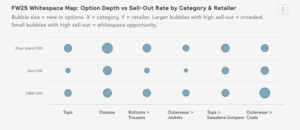
Whitespace, grounded in what’s proven. With open-to-buy tighter across the region, there’s less appetite for a bet based on instinct. Whitespace identification that’s grounded in live category and pricing data, rather than assumption, lets buyers commit to what the market has already validated instead of what looks like a gap on paper. AskEDITED, EDITED’s conversational retail intelligence tool, answers exactly this kind of question directly. A buyer can ask “where’s my safest whitespace this season given a tighter open-to-buy?” and get a sourced answer in seconds, not a week of pulling reports together first.
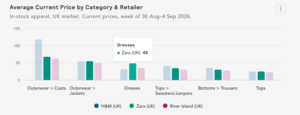
Pricing precision. A range that’s priced even slightly above competitor average is margin quietly leaking out of the business. Flagging those products, and putting an estimated margin uplift against correcting them, turns pricing from a once-a-season exercise into something a team can act on continuously.
Markdown discipline. When ranges are leaner by necessity, over-discounting to move stock does more damage than it should. Protecting margin here means selling through what you have efficiently, rather than defaulting to depth of discount the moment sell-through slows.
None of this requires a bigger team or a bigger budget. It requires the current picture, not last quarter’s.
Doing more with a smaller or frozen team
For many teams in the region right now, the honest constraint isn’t budget for new tools. It’s headcount that isn’t moving, against a workload that isn’t shrinking.
McKinsey’s research puts a real number on where that time goes: merchants can reclaim up to 40% of their time by offloading manual, data-gathering work to AI agents, freeing them up for the parts of the job that actually need a person: strategy, vendor conversations, product calls.
EDITED customers are already seeing that play out in practice. A weekly trade report that used to take three hours can be delivered in three minutes. If headcount is frozen, that’s the highest-leverage move available: not asking the same team to cover more ground, but cutting the manual overhead so the ground they already cover takes a fraction of the time.
What this looks like in practice
This isn’t abstract. It’s the kind of question a buyer or planner in the region is asking right now, just without an easy way to get a fast, sourced answer:
- “Where is my safest whitespace this season, given a tighter open-to-buy?”
- “Which SKUs are priced above competitor average right now?”
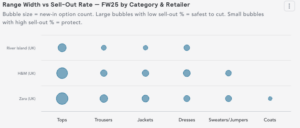
- “Where can I cut range without cutting sell-through?”
That’s the gap AskEDITED and EDITED MCP close from two different directions.
AskEDITED is built for the buyer or planner who wants a fast, expert answer in natural language, no dashboards, no superuser required.
MCP, now live for Claude Desktop, custom agents and developer environments, is built for teams who want to combine EDITED’s market data directly with their own internal numbers (margin, inventory, POS) inside the AI workspace they’re already using.
One gets you a fast answer. The other lets you build that answer straight into how your team already works.
Protecting margin is a capital allocation argument
Zoom back out to the boardroom, and this stops being a data story and becomes a capital allocation one. The Middle East retailers protecting margin best through this period aren’t the ones spending more; they’re spending smarter, with the data to back every call they take to leadership.
Caution doesn’t have to mean standing still. It just means being right more often, with less room for error, and faster proof to show for it – EDITED was built for this.
Frequently asked questions
How can Middle East retailers protect margin during a cautious investment climate?
By focusing on the margin already available in the business rather than new spend: whitespace grounded in proven demand, pricing corrected against competitor benchmarks, and markdown discipline that avoids over-discounting a leaner range.
What is AskEDITED?
AskEDITED is EDITED’s conversational retail intelligence tool. Buyers, merchants and planners ask questions in natural language and get expert, sourced answers in seconds, no dashboards or superuser setup required.
What is EDITED MCP?
EDITED MCP puts EDITED’s market data directly inside the AI workspace a retail team already uses, such as Claude, letting them combine external market intelligence with their own internal numbers like margin, inventory and POS data.
How much time can AI agents save a merchandising team?
McKinsey estimates merchants can reclaim up to 40% of their time by offloading manual, data-gathering work to AI agents. EDITED customers have seen weekly trade reporting drop from three hours to three minutes using Workflows.
Want to understand more about how EDITED could support your team specifically? Book a demo with one of our AI retail experts.